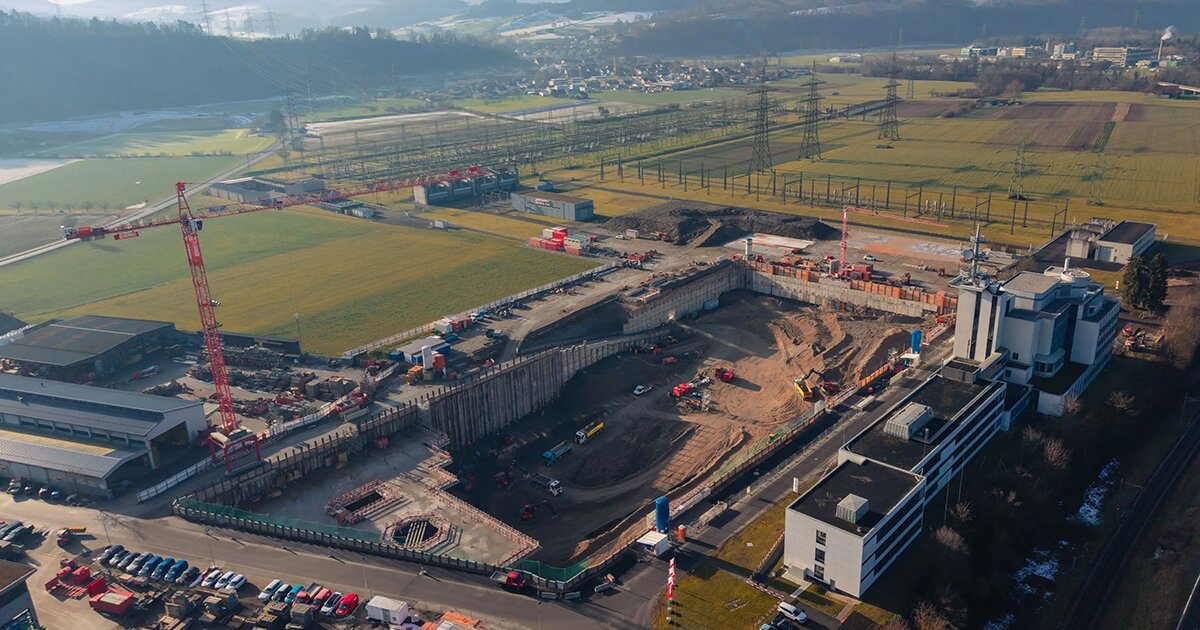
In northern Switzerland, a construction team is hard at work excavating a hole in the ground that will end up being over 88 ft (27 m) deep, and spanning the length of two soccer pitches. This pit will be home to Switzerland's first redox flow battery for storing clean energy – and it'll be the most…


Does this make sense? How the hell do you transfer that much energy in milliseconds? Especially with a battery that requires the flow of liquid?
The article was written by someone who doesn’t understand the difference between power and energy. It’s an extremely common mistake to mix up Watts and Watt-hours, or assume they’re the same thing.
If this is some sort of hybrid battery that could be possible… Super capacitors take the initial charge, pass it on to the flow battery. But as far as I know, absorbing or releasing a lot of energy quickly is just not what flow batteries do, it’s their biggest limitation.
This article is complete bullshit. What they probably meant is that it can switch between energy input and output within milliseconds, which is realistic. Whoever wrote this lacks a basic understanding of the technology.
From what I read, it does 800 MW max, which is still a lot.
1.2 GWh is just the capacity. And response time can indeed be quite fast as the system is always on standby, but I would guess it would still take a few seconds to go from zero to full power
But with 800 MW it takes an hour and a half to get to 1.2 GWh, and an hour is 3600 seconds or 3600000 ms. So “a few” is doing a lot of work in that quote.
The quote is obviously incorrect, perhaps the engineer meant to say “absorb 1.2 GWh and start providing power to the grid in a matter of milliseconds”, and it was lost in translation.
I mean, you COULD just have a massive membrane area. They won’t, cause that’d be crazy, but you could.
True, but that would kind of defeat the purpose of it being a flow battery, I think.