That’s just not how phased array systems work. The system we’re talking about needs to have excruciatingly tight and correct timings regarding signal transmission and reception. These are beam forming systems, so a multidimensional array of antenna are using to steer the beam, using constructive and destructive interference to “point” the energy where you want it to go. That alone requires extremely tight timing. That’s coupled with a phased array receiver system, so that you can detect very slight changes in the wavelength/ speed of the return signal to apply the doplar effect to detect things like motion. The github states that this system operates at 10.5 GHz, of which one RF cycle is about 95 ps, ~2.5cm. This puts the practical per-element beamforming granularity/error budget is very much in that sub-picosecond to picosecond-equivalent range. That would be practically impossible for anything but a coupled system.
Not completely impossible, I mean, probably US military systems exist in a decoupled system. But its technologically way, way way harder because timings need to be nano to pico second correct.
Maybe they could be synced using RF over fiber. This has been proposed as candidate technology for 6g wireless networks, to enable cell free massive MIMO.
That would mean that you would need to run optical fiber to each of them, though we’ve already seen fiber drones spool out kilometers of the stuff as they fly.
EDIT: I just remembered this interesting article about doing radio interferometry over a fiber network using cheap quartz oscillators instead of atomic clocks. My (layman’s) understanding is that the quartz oscillators are good enough over a few milliseconds, but will fall out of sync with each other over longer time spans. Meanwhile the fiber optic reference signal (distributed from a central atomic clock) can be kept correct on average by reflecting the reference back down the fiber and doing active correction of the changing path length (caused by thermal fluctuations and vibrations along the fiber) but will be incorrect on a millisecond-to-miliscond basis because of light speed lag and the path length being a moving target. So they use the quartz oscillators over small time scales and use the fiber reference signal to keep them synced over long time scales. Surprisingly the article says they actually get a better sync this way than with using multiple atomic clocks.


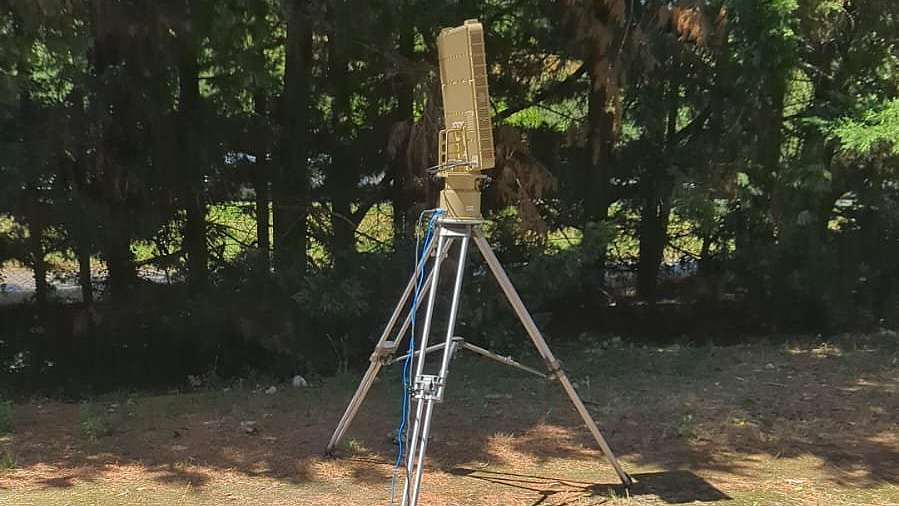
That’s just not how phased array systems work. The system we’re talking about needs to have excruciatingly tight and correct timings regarding signal transmission and reception. These are beam forming systems, so a multidimensional array of antenna are using to steer the beam, using constructive and destructive interference to “point” the energy where you want it to go. That alone requires extremely tight timing. That’s coupled with a phased array receiver system, so that you can detect very slight changes in the wavelength/ speed of the return signal to apply the doplar effect to detect things like motion. The github states that this system operates at 10.5 GHz, of which one RF cycle is about 95 ps, ~2.5cm. This puts the practical per-element beamforming granularity/error budget is very much in that sub-picosecond to picosecond-equivalent range. That would be practically impossible for anything but a coupled system.
Not completely impossible, I mean, probably US military systems exist in a decoupled system. But its technologically way, way way harder because timings need to be nano to pico second correct.
Maybe they could be synced using RF over fiber. This has been proposed as candidate technology for 6g wireless networks, to enable cell free massive MIMO.
That would mean that you would need to run optical fiber to each of them, though we’ve already seen fiber drones spool out kilometers of the stuff as they fly.
EDIT: I just remembered this interesting article about doing radio interferometry over a fiber network using cheap quartz oscillators instead of atomic clocks. My (layman’s) understanding is that the quartz oscillators are good enough over a few milliseconds, but will fall out of sync with each other over longer time spans. Meanwhile the fiber optic reference signal (distributed from a central atomic clock) can be kept correct on average by reflecting the reference back down the fiber and doing active correction of the changing path length (caused by thermal fluctuations and vibrations along the fiber) but will be incorrect on a millisecond-to-miliscond basis because of light speed lag and the path length being a moving target. So they use the quartz oscillators over small time scales and use the fiber reference signal to keep them synced over long time scales. Surprisingly the article says they actually get a better sync this way than with using multiple atomic clocks.
So perhaps something like that is possible.