

I think we should send robots, instead. And, not just to Mars.
Interesting read, this part caught my eye:
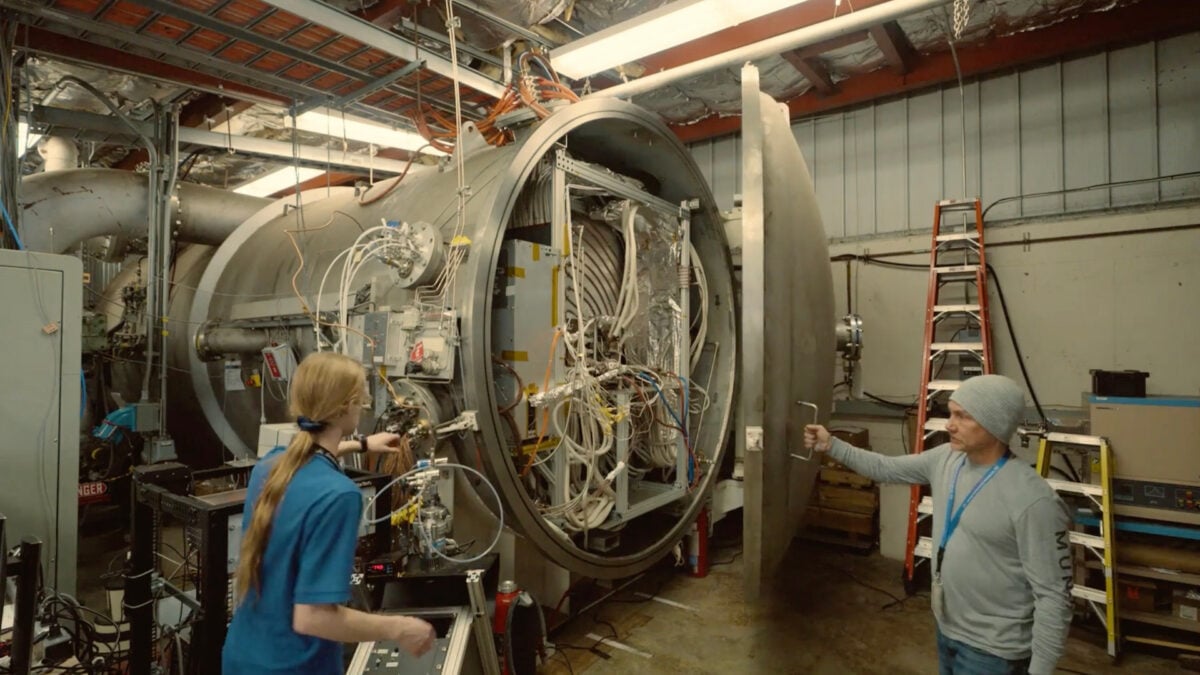
Launching a crewed spacecraft to Mars might require 2 to 4 megawatts of power, meaning multiple MPD thrusters operating for more than 23,000 hours. This presents a challenge as the hardware operates at high temperatures, and the team needs to prove that the thruster’s components can withstand the heat for multiple hours during upcoming tests.
Would the thrusters really run the full 23k hours? That’s just shy of 960 days, surely once you reach a certain speed you wouldn’t need to run them continuously at full power.
Some ion trajectories involve constant low acceleration. It really adds up time. You accelerate halfway there, then decelerate the rest of the way.
The dawn spacecraft mission to ceres has 48,000+ hours of gentle acceleration under ion propulsion. That’s 5.5 years of firing. But it gets over 38,620 km/h of delta-v (acceleration).
https://www.jpl.nasa.gov/news/nasas-dawn-spacecraft-fires-past-record-for-speed-change/
That’s to Ceres, Mars is only 9 months, so how do we get from 9 months to 23k hours?
9 months is a typical direct transfer, using a traditional rocket engine whose thrust is so high you can basically treat it as infinite: accelerate up to your transfer speed in a few minutes and coast until you need to slow down in a similarly negligible amount of time. You need to set a lot of gas on fire in those few minutes, though. Electric propulsion is so low thrust that it can’t put you on that kind of direct trajectory in one go, so the trip is more of a slow spiral around the sun with continuous thrust the whole way. The tradeoff for everything taking forever is unbelievable fuel savings, which is a surprisingly common occurrence in space travel.
deleted by creator
Launching a crewed spacecraft to Mars might require 2 to 4 megawatts of power, meaning multiple MPD thrusters operating for more than 23,000 hours.
Btw, what happened with the VASIMIR engine after the ISS tests in 2011ish? I think i’ve read that it could do the whole trip in 5 months (high-impulse insertion burns, high-speed & low-impulse travel). Somewhere on the shelves? Too high power draw?
What was it again? 1 Watt is ~= lifting a 100g schoko 1 meter (ignoring inefficiencies in muscles). Did i get the unit right?
How many grams of hamster is it per gram of schoko
ca. 1 banana.
Did they decide if this type of thrust is actually possible and not just a poorly designed experiment?
Edit, nevermind, this isn’t the microwave thing
The em drive is what you’re thinking of, this is something different. That thing dropped off the radar a long time ago.
There is a new one in the works, but forget what it is called.
I want it to exist so bad.
Edit:
Charles Buhler’s work. Dunno if it has a name
Interesting rabbit hole. Thanks.
Buhler? Buhler?


