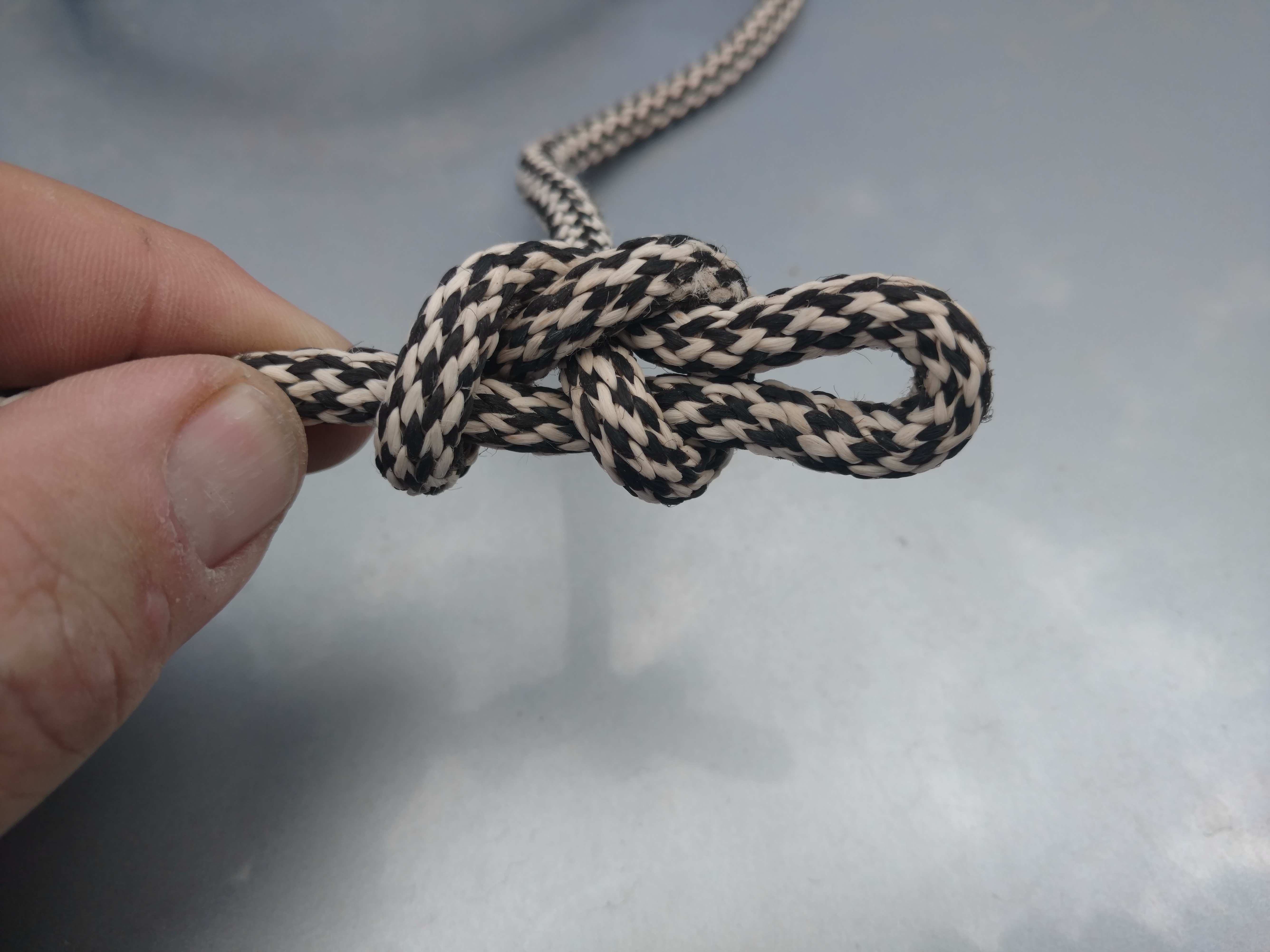
Years ago I bought a canoe, the ropes had several of these knots. I have never been able to replicate them (granted I have not tried a lot either).
Some other angles:
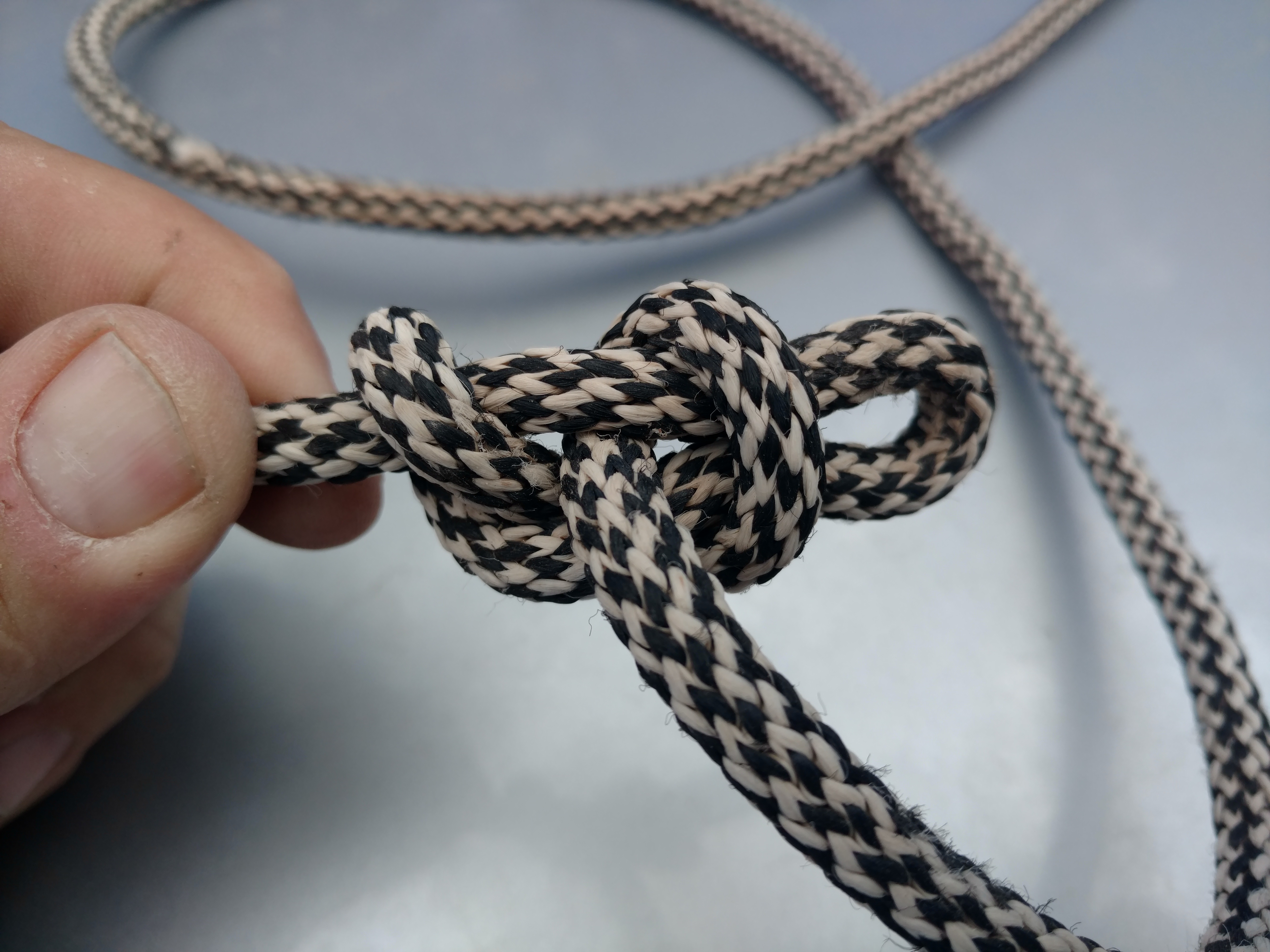
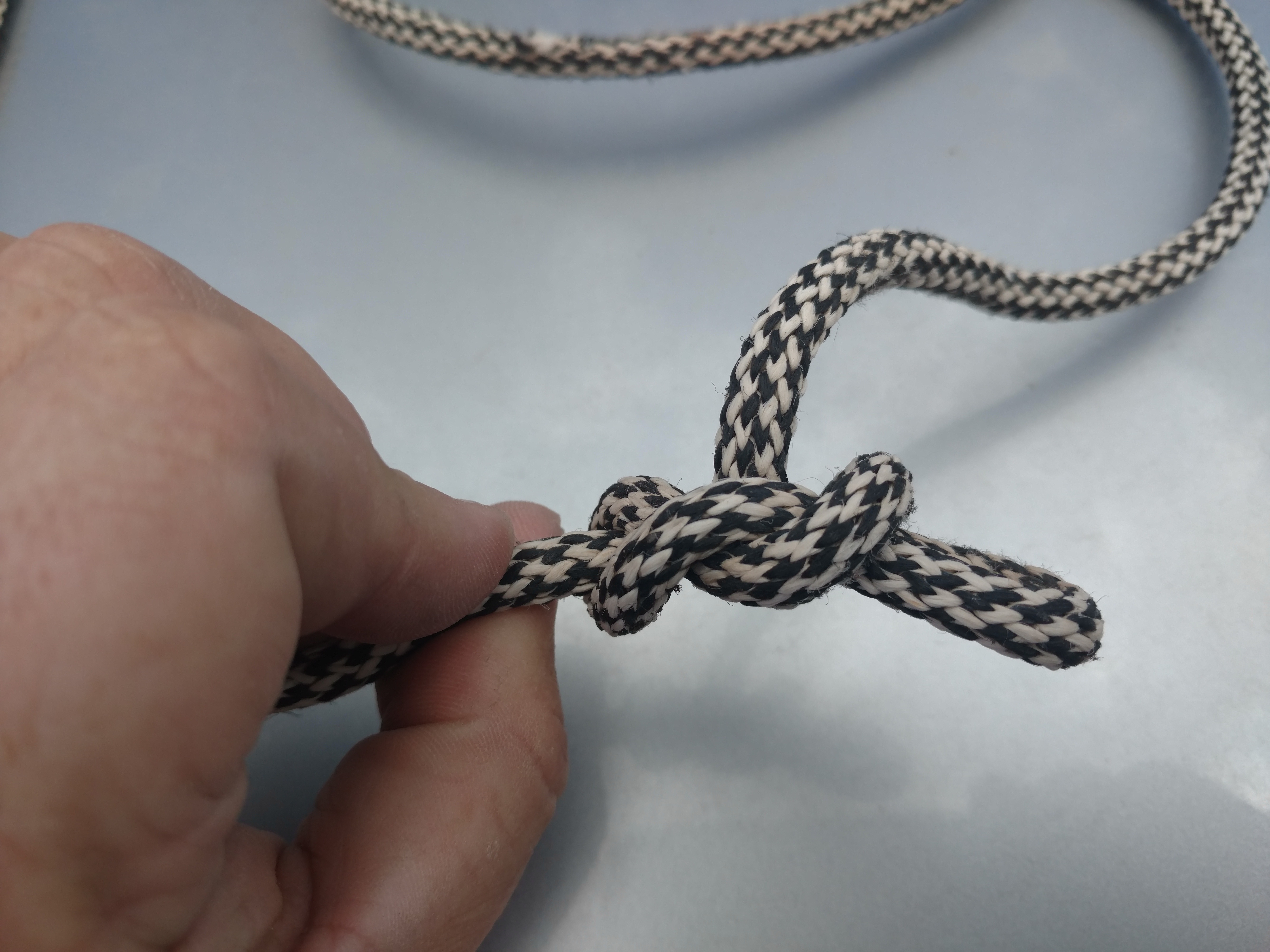
I’d call that a mooring loop, and the loop part goes around the post. I tie up my horse with that and I’ve done it for so long, I don’t really think about how I do it.
You put the line around the post, twist the long side (halter side) so you make a loop, and pass a loop of the tag end through it, then drop the tag end through the second loop. If the horse pulls, it tightens up both loops but you can pull the tag end out and it comes undone.
I think it’s a standard figure 8 but with one side pulled through into a slipknot.
Not sure if that has a specific knot name. Knowing sailors, it’s probably something that sounds like a drunken slur.
That was my first thought as well. Probably called a “slipped” or “slippery” figure-8.
Slippy-8
Pronounced: Schlipght
Gesundheit
“Steve” and “very carefully”, respectively.
Possibly the buntline hitch? Wiki link, animated knots link.
Yep I’ll second this, if you follow the rope it makes a clove hitch on the loose end, which matches this knot
This is correct, that’s a buntline hitch.
The images in the wiki look a lot like OP’s photos, and given the description they gave of how they used them, that is consistent with a Buntline hitch as well.
Kind of looks like a mooring hitch, but backwards. It won’t actually do anything that loop will pull immediately.
If you look at the loop as what goes around the post, it’s a mooring hitch/loop. It just pulls tight if you pull the long end, and the short tag end stops the other loop from pulling through. You pull the tag end out and it falls apart.
When I loaded the canoe onto my suv the seller and I used the loop in the knot to tie a trucker’s hitch to secure the canoe to my roof.
Depends on which end you pull, it looks like
Is that an alpine butterfly? I know of at least 3 ways to tie it. It’s an excellent knot for making a loop. It won’t capsize under load, doesn’t damage the line it’s tied in and can always be untied no matter how much load it was under.
If I wanted to tie a loop in the middle of a line I’d use an alpine butterfly. https://www.animatedknots.com/alpine-butterfly-loop-knot
Looks like a bowline, but with more steps…

It’s not a bowline, the knot in the image slips and will pull through if you pull one end, a bowline is fixed
Do they serve a function?
There were already in the line when I got the canoe, the seller helped me load it onto my suv. We used the loops to tie a trucker’s hitch to secure the canoe.
What function they served prior to my purchase is unknown. There were two ropes, one tied to each the bow deck and the stern deck. They were tied at the center of the rope with equal lengths on either side of the loop on the deck. Then near the end of each end of the rope was one of these knots.
What is it supposed to do? It seems like come loose if you pull from one end and tight from another?
Unsure of its original purpose, but when I purchased the canoe, the seller belied me load it and we used trucker’s hitches going through the loops of these knots. From what I remember the loop did not slip when pulled, but if you pulled the tail the whole knot came undone.
It does look like a hitch of some sort. If you are trying to achieve a loop that does not pull tight, I always used a bowline knot.
Does a figure 8 on a bight not do the same?
It does, but the bowline is easier to untie after an extreme load. But then the bowline is not safe on it’s own, it needs to be backed up with another knot. An overhand on a bite also serves the same function but I think that’s even harder to untie after loading especially with skinny material. Not sure about that though, I’ve just heard of people not being able to untie them in their anchors for rock climbing.
Also figure 8 requires the most rope, still my favorite knot though
I am not an expert by any standards, that is just one I remember from scouts. I had to look up figure 8 on bight, and that looks like a really useful knot, especially because you can do in the middle of rope, without the end. I looked up why anyone would do a bowline then, but i guess it’s a little easier to undo when you’re done with the knot, so it’s useful in certain rescue situations, otherwise the figure 8 is considered stronger. Do you have experience with either?
Bowline is used in rigging for lifting purposes to tie tag lines
Also great for saving yourself when thrown a rope in the ocean to pull back to safety.
How long is the end you are holding?
This was taken back in 2017, one end goes to the canoe, the other end was not terribly long. I will see if there is still one knot tied, which there may be as we do not have much water in New Mexico any longer and taking the canoe out to a dry riverbed is not much fun.
Edit: the knot is gone from where I was to undo and recreate the knot. But I can still see the area where it was tied. There is about 40" of rope after where the knot was.
It looks like you could make a loop and twist it, and then pass the loop end through the twist somehow to recreate this knot instead of threading the end through
Edit: google mid-loop knots and see if you can find it that way
Edit 2: rigging knots and loop knots
Not sure how you can’t figure it out by just looking at them but in case it helps: fold to make the first loop, then wrap around, tuck through, wrap around and tuck through again. Good luck on finding out what goes where in that sentence.
Perhaps a variant on the trucker’s hitch? (Assuming that this was used to tie the canoe to the roof of a car.)
As for tying it, it looks like you tuck a bight in the running end behind the standing end, and pull it through the loop formed by doing so.Edit: No, on second look, it’s not that.For anyone struggling with tying a truckers hitch knot, please see this instructional video